Plan your death, Maximize your life.

There’s a question that doesn’t usually get asked until it’s too late.
What if you could go back—armed with everything you now know—and choose differently?
Not just the obvious choices. But the subtle ones. The ones that quietly shaped your entire life while you weren’t looking.
The relationships you stayed too long in. The truths you didn’t say out loud. The version of you that got edited down to be acceptable, productive, “fine.”
Now imagine something else.
Not a fantasy of undoing the past—but a deeper intelligence entering your present.
A way of living where you are no longer only planning for success… but also for wholeness. For endings. For the full arc of a human life.
Because here’s the truth most people avoid:
You are already in a relationship with your death. The only question is whether it’s unconscious—or conscious.
And that changes everything.
When you begin to include the end in your awareness, something strange happens. Life doesn’t become darker. It becomes sharper. More honest. Less negotiable.
You start noticing where you’re living on autopilot—doing what you “should” instead of what you actually desire. You start asking questions that don’t fit neatly into productivity culture:
Is this my life… or a performance of one? Am I choosing this—or inheriting it? If everything ended sooner than expected, what would feel unfinished inside me?
Most people never ask those questions until a crisis forces them open.
But there is another way.
To live as someone who doesn’t wait for collapse to become clear.
Because planning for the end is not morbid—it is precision.
It is the quiet act of taking responsibility for your time, your relationships, your body, your impact, your exit.
And it does something unexpected: it makes life more alive.
You begin to understand what actually matters.
Not in theory. In behavior.
You stop confusing urgency with meaning. You stop outsourcing your decisions to expectation. You stop assuming there will always be “later.”
And slowly, your relationships deepen—not because they become easier, but because they become more real.
Conversations get cleaner. Boundaries get clearer. Love becomes less performative, more honest.
Even the idea of death changes shape.
It stops being a shadow in the background and becomes a teacher in the room.
Not threatening you—but refining you.
Because when you are willing to acknowledge the end, you start to live with a different kind of intelligence. You begin to prepare—not out of fear, but out of respect for the unpredictability of being alive.
And here’s something most people don’t realize until they’ve faced it: when major life challenges arrive—unexpected loss, illness, breakup, financial disruption, identity collapse—you are not starting from zero.
You already have a map.
A way of orienting.
Because when you’ve done the inner work of acknowledging endings, clarifying values, and naming what matters, disruption doesn’t destroy you in the same way. It doesn’t erase you. It doesn’t scatter you without reference points.
You have a navigation system.
A way to move through chaos with more coherence. A way to make decisions under pressure without abandoning yourself. A way to return to what is true when everything else is shaking.
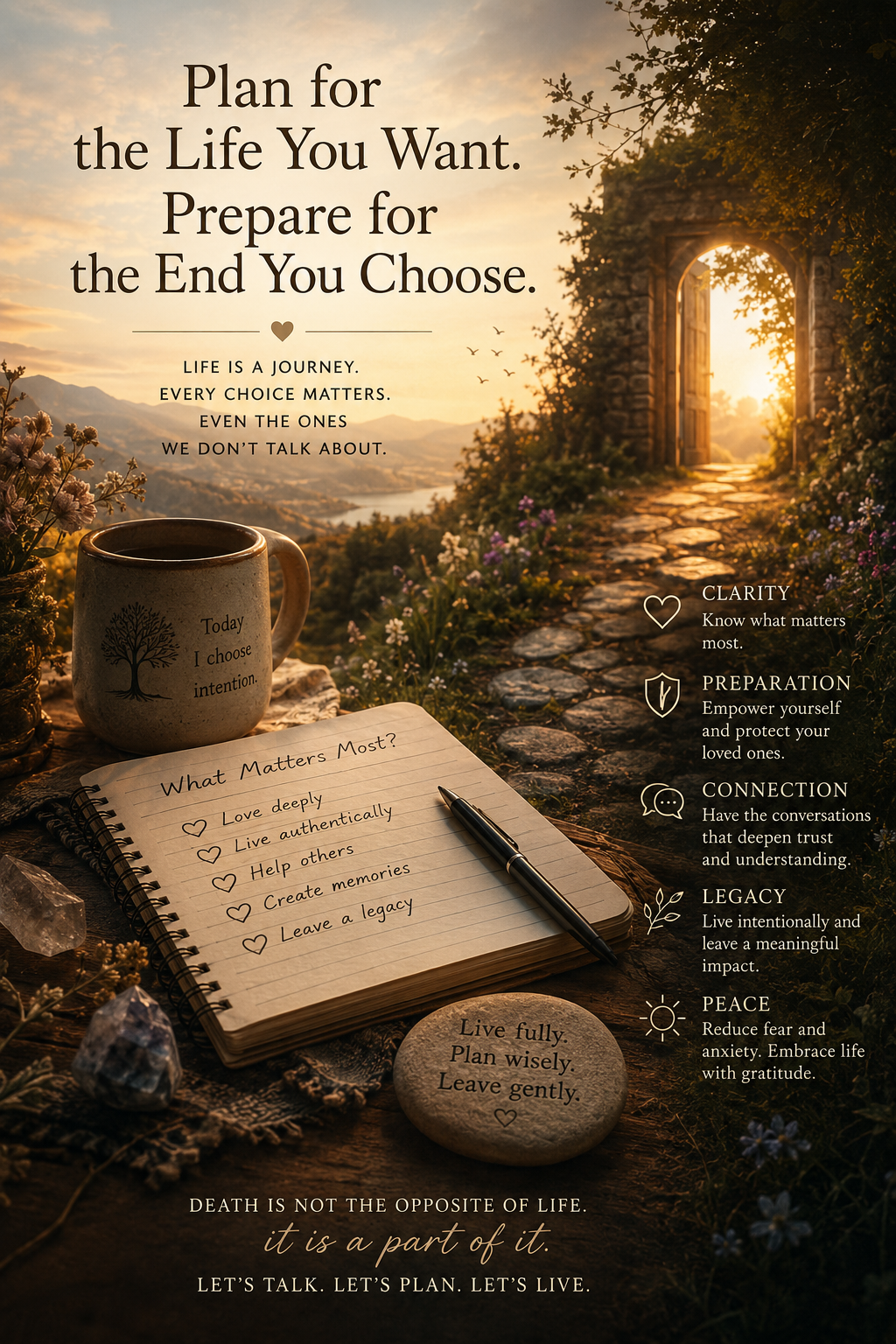
What would it mean to have your wishes known before they are needed? To have your values documented before crisis distorts them? To spare your loved ones the burden of guessing who you were when it matters most?
This is not planning for disaster.
This is designing coherence.
A life where your choices are not left scattered for others to interpret in confusion or grief.
And something else happens too.
You start to loosen your grip on control.
Because when the end is no longer avoided, the present becomes less fragile. Less performative. More spacious.
You stop trying to outrun life.
And begin to actually inhabit it.
This is not about thinking about death all the time.
It is about refusing to pretend it isn’t part of the architecture of being here.
Because once you include it, everything else becomes more intentional:
How you love. How you work. How you rest. How you repair. How you leave.
And quietly, without drama, your life starts to align.
Not because it became perfect.
But because it became honest.
And honesty—when fully lived—is its own kind of freedom.
Willow
If something stirred while you were reading this…
Trust it.
The life you’re longing for may be waiting on the other side of a conversation you’ve been afraid to have…
Hidden beneath a pattern you’ve never learned to see.
If you’re ready, schedule a private conversation with me.
Let’s begin.