Power Doesn’t Lie

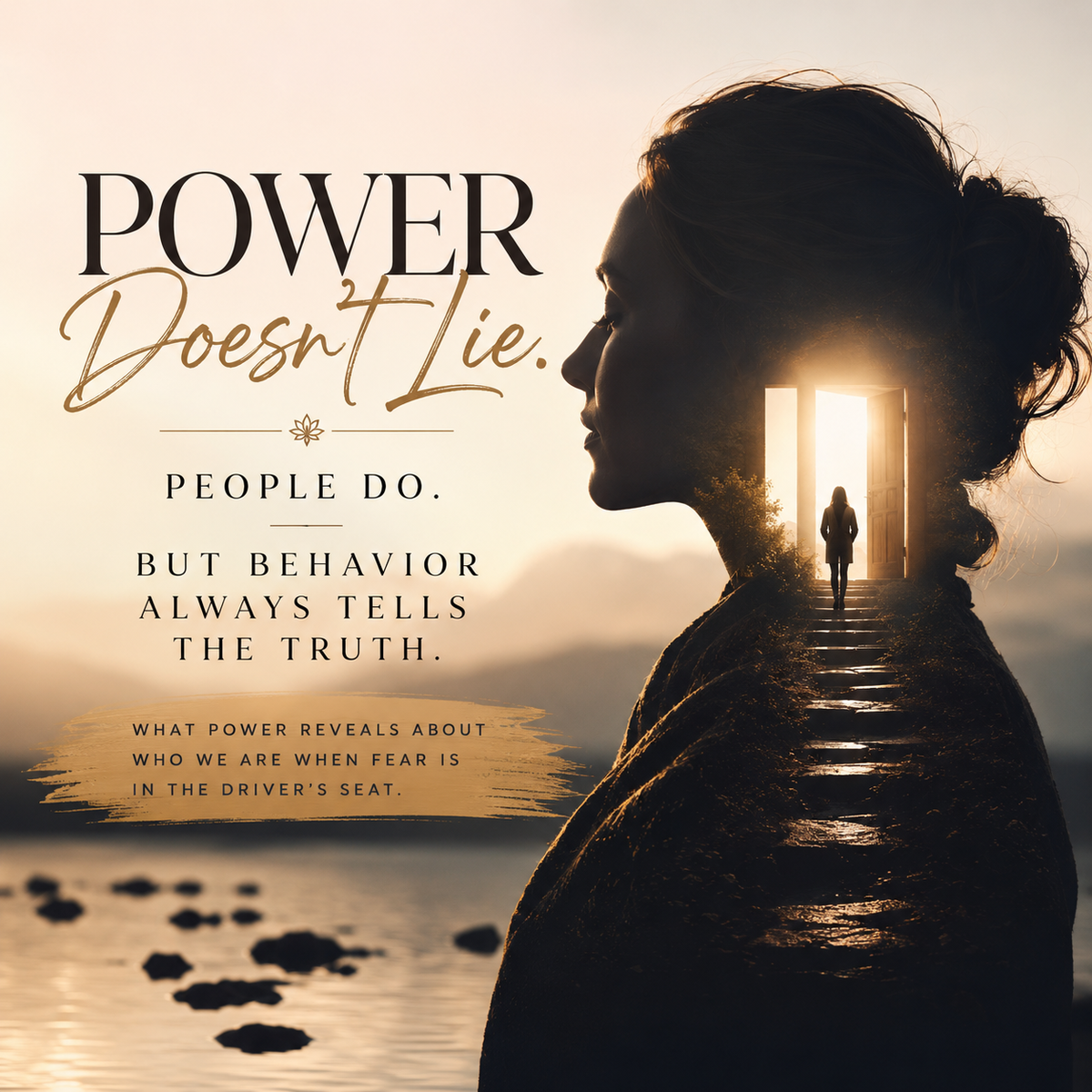
What power reveals about who we are when fear is in the driver’s seat
Power is not what we think it is.
It’s not something you acquire. It’s something that reveals you.
Most people chase power because they believe it will complete them.
But power doesn’t complete anyone.
It exposes what is already there.
Real power isn’t measured by how much control you have over others.
It’s revealed by what you do when you’re entrusted with influence.
When someone is handed the microphone, the authority, the narrative, or the opportunity to lead, their relationship with power becomes visible.
Do they use it to uplift or to diminish?
To create safety or fear?
To build bridges or hierarchies?
To tell the truth—or to protect the story that benefits them?
Power doesn’t create character.
It reveals it.
The ripple of influence
Every decision, every conversation, every story we tell reaches far beyond what we can see.
Used with integrity, power restores trust, inspires healing, and expands possibility.
Misused, it fractures relationships, divides communities, and leaves wounds that continue long after the moment has passed.
Power reveals where fear is still driving behavior.
And behavior always tells the truth.
When power shows up in our darkest moments
Yet some of the most defining expressions of power don’t happen when we’re leading.
They happen when we’re falling apart.
There are moments in every life when we are standing at the edge of ourselves.
When we’re grieving.
When we’re ashamed.
When we’re broke.
When we’ve lost our way.
When we wonder if life is even worth continuing.
And sometimes, in those moments, someone reaches out a hand.
They pay the rent.
They open a door.
They offer a place to stay.
They believe in us before we’re capable of believing in ourselves.
They are not just helping us survive.
They are handing us power—the opportunity to reveal who we actually are.
In that moment, we have a choice.
Do we allow that gift to become the foundation for truth, responsibility, and transformation?
Or do we use it to protect the very story that keeps us trapped?
Fear whispers that another lie will keep us safe.
That if we can hold the narrative just a little longer, we’ll avoid what’s waiting underneath it.
But what is out of alignment does not stay hidden forever—it asks to be made whole.
The weight of what we carry
The stories we tell others may protect our image for a while.
But the stories we tell ourselves determine our peace.
Every false narrative becomes a weight we carry.
Every act of honesty sets something down.
The measure of our character isn’t whether we fall.
It’s what we do next.
Owning the impact of our actions. Telling the truth. Making amends where we can. Repairing what is ours to repair.
These acts require far more courage than defending a false narrative ever will.
That is power.
Because every time we choose image over integrity, we give our power away.
Every time we defend what is not true, we become bound to it.
The more we resist truth, the heavier the distance grows between who we appear to be and who we know ourselves to be.
Truth as liberation
Eventually, truth asks to be spoken.
Not to punish us.
But to free us.
Sometimes the hardest part isn’t being in the darkness—it’s receiving the help that forces us to face our fear and choose integrity in spite of it.
When we finally choose honesty, something shifts.
We stop performing a version of ourselves.
We stop carrying what was never ours to hold forever.
We become available for repair.
For trust.
For peace.
What real power becomes
Power without consciousness becomes control.
Power without integrity becomes manipulation.
But power rooted in love, truth, humility, and responsibility becomes service.
It does not demand followers.
It does not require domination.
It does not protect an image.
It simply stands in truth.
And in doing so, it gives others silent permission to do the same.
Closing reflection
Before asking for more power, ask yourself:
If more were placed in my hands today, would the people around me experience more freedom—or less?
Because power is not measured by how many people follow you.
It is measured by what happens to people when they are in your presence—
Do they become more free, more honest, more themselves… or less?
And ultimately:
Power doesn’t lie. People do. But behavior always tells the truth.
-Willow
If this spoke to something in you, you’re not alone in that recognition.
There’s a deeper conversation beneath power, beneath patterns, and beneath the moments we’ve protected our image instead of our truth.
If you’re ready to explore that more honestly—what power looks like in your life, your relationships, and the places you’ve had to choose between fear and integrity—there’s space for that.
You don’t have to figure it out alone.
Come closer. Let’s look at it together.