
The Art of Listening

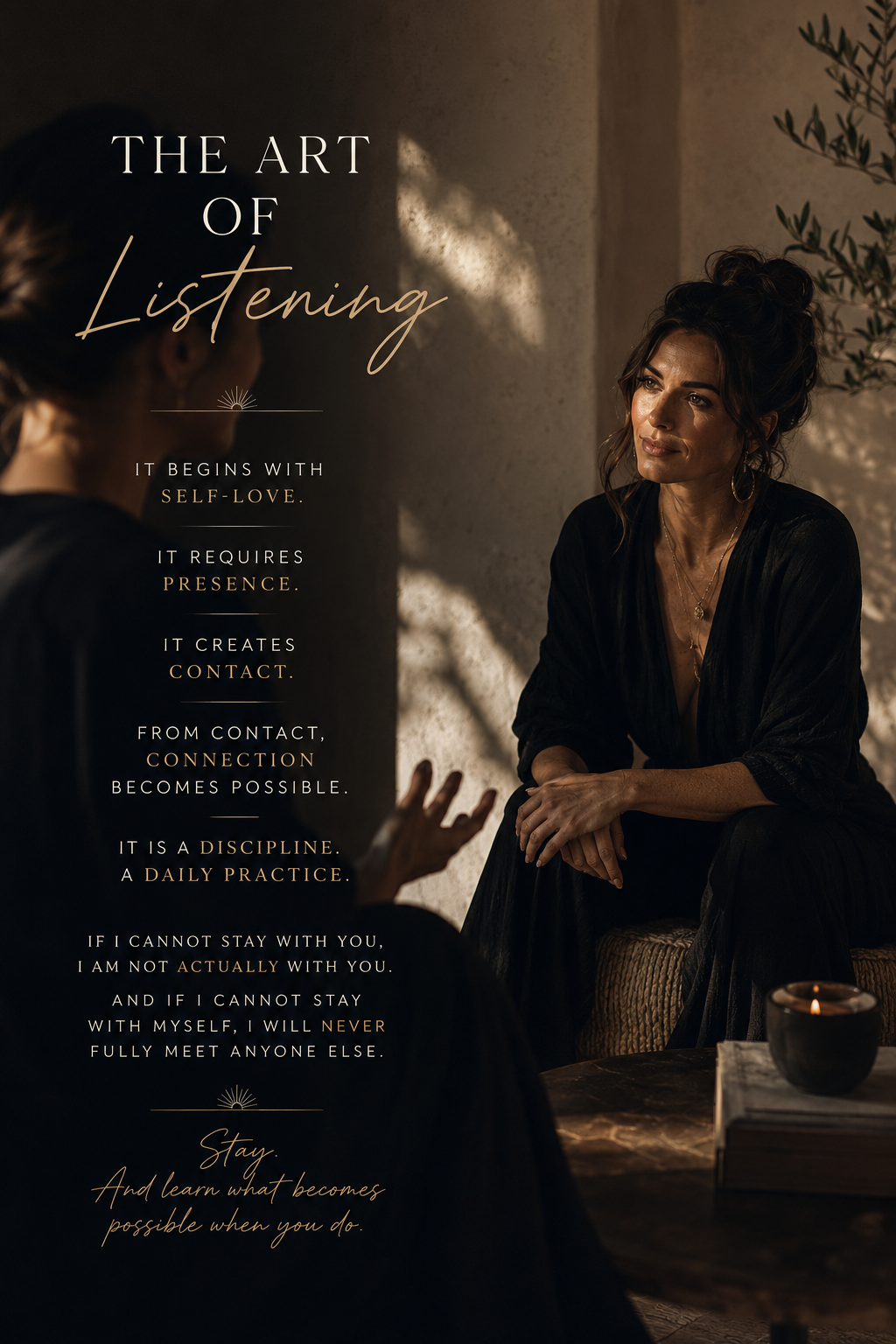
The art of listening is not casual. It is not polite. It is not background behavior.
It is a discipline.
Most people believe they are listening when they are simply waiting. Waiting to respond. Waiting to correct. Waiting to reveal how much they already know. Waiting for the pause so they can enter the space with their answer, their story, their certainty.
But true listening is something else entirely.
It is the ability to stay with a person without taking them from themselves.
To hear them without interrupting the unfolding. To witness them without translating them into your own experience. To let silence do its work without rushing to fill it with meaning.
And you can feel the difference instantly.
A conversation begins to tighten when someone is not being met. The speaker starts to drift away from themselves mid-sentence. The energy retracts. Not because what they’re saying lacks value—but because it is not being received, only processed.
This is where people begin to disappear in relationships and never quite know why.
Not because they were rejected outright. But because they were never fully met in the first place.
And I would add this—because it belongs here.
This is not just about listening.
It begins with self-love.
Not the conceptual kind. Not affirmation. Not performance of acceptance.
But the kind of self-love that is actually self-receipt.
The kind where you are no longer abandoning yourself in real time.
Because when you are truly at peace with yourself—when there is nothing in you that you are trying to escape, fix, improve, or outrun—something softens in your capacity to be with another human being.
You are no longer listening through the filter of insecurity. You are no longer scanning for where you fit in the story. You are no longer preparing yourself to be enough.
You are simply there.
And from that place, receiving someone else becomes effortless.
Not because they are easy to hear— but because you are no longer divided against yourself while hearing them.
This is the part most people miss.
They think listening is a skill directed outward.
But it is actually a byproduct of inner coherence.
Because when you are not at war with your own experience, you can stay with another person without needing to alter them, redirect them, or use them to stabilize you.
You can let them be what they are without interference.
And this is where it becomes more precise.
This is not just about connection.
It is about contact.
Contact is the moment-to-moment reality of two people actually meeting—without distortion, without escape, without performance.
Most people believe they are in connection when they are actually in projection. They are relating through interpretation, memory, assumption, and the subtle need to be seen in a particular way.
But contact is different.
Contact is immediate. Undiluted. Present.
And from contact, connection becomes possible—real, unforced, and clean.
And there is something else underneath all of this.
Most people are not actually trying to be understood in the way they think they are.
They are trying to be received—but they do not know what being received actually means.
Because being received is not being agreed with. It is not being fixed, mirrored, advised, or made comfortable.
To be received is to be met without distortion.
And for many people, that kind of meeting is unfamiliar enough to feel unsafe.
So instead, they perform being known.
They speak to be seen, but do not stay present long enough to be seen. They listen to respond, not to receive. They ask questions, but often as a bridge back to themselves. Not because they are cruel or unaware—but because they have never learned how to remain with another person without inserting themselves into the space as interpretation.
And underneath even that, something more tender is happening.
The interruptions. The fixing. The over-talking. The constant reframing of another person’s experience.
It is not just communication style.
It is a nervous system trying to escape the intensity of presence.
Because presence does not allow performance to hide.
When you are actually with someone—without escape into advice, identity, or story—you are confronted with yourself at the same time.
And most people unconsciously leave at that point.
So they manage the moment instead of entering it. They shape perception instead of meeting truth. They stay close enough to feel involved, but not close enough to be changed.
But real listening—real receiving—does something different.
It slows everything down.
It asks nothing except honesty.
And in that space, something becomes undeniable:
If I cannot stay with you, I am not actually with you. And if I cannot stay with myself, I will never fully meet anyone else.
And this is why it matters to name it clearly.
This is not a personality trait. It is not something you either have or you don’t.
It is a practice.
A discipline.
The art of listening—of being in contact, of receiving another human being without distortion—is not mastered in a moment of insight. It is built slowly, through repetition, through awareness, through the willingness to notice when you leave and return again.
Because you will leave.
Everyone does.
You will interrupt. You will fix. You will reach for meaning too quickly. You will prepare your response instead of staying with the person in front of you.
And the practice is not perfection.
The practice is return.
Over and over again—returning to presence. Returning to the body. Returning to the person speaking. Returning to what is here before interpretation takes over.
This is how contact is built.
Not through becoming a “good listener,” but through the quiet humility of noticing departure—and choosing, again and again, to come back.
And like any discipline that matters, it requires practice.
Daily practice.
Because what we are really talking about is not communication.
It is contact with life itself.
And most people are not absent because they don’t care.
They are absent because they were never taught how to stay.
And the quality of that staying—changes everything.
Stay. And learn what becomes possible when you do.
-Willow

The conversation that changes your life is rarely the one where someone gives you the answer.
It’s the one where, perhaps for the first time, you feel completely received.
If something in you softened as you read these words, trust that.
There is a different way to meet yourself.
A different way to meet the people you love.
A different way to move through life.
It begins with one conversation.
Come as you are.
Stay.
Let’s begin.